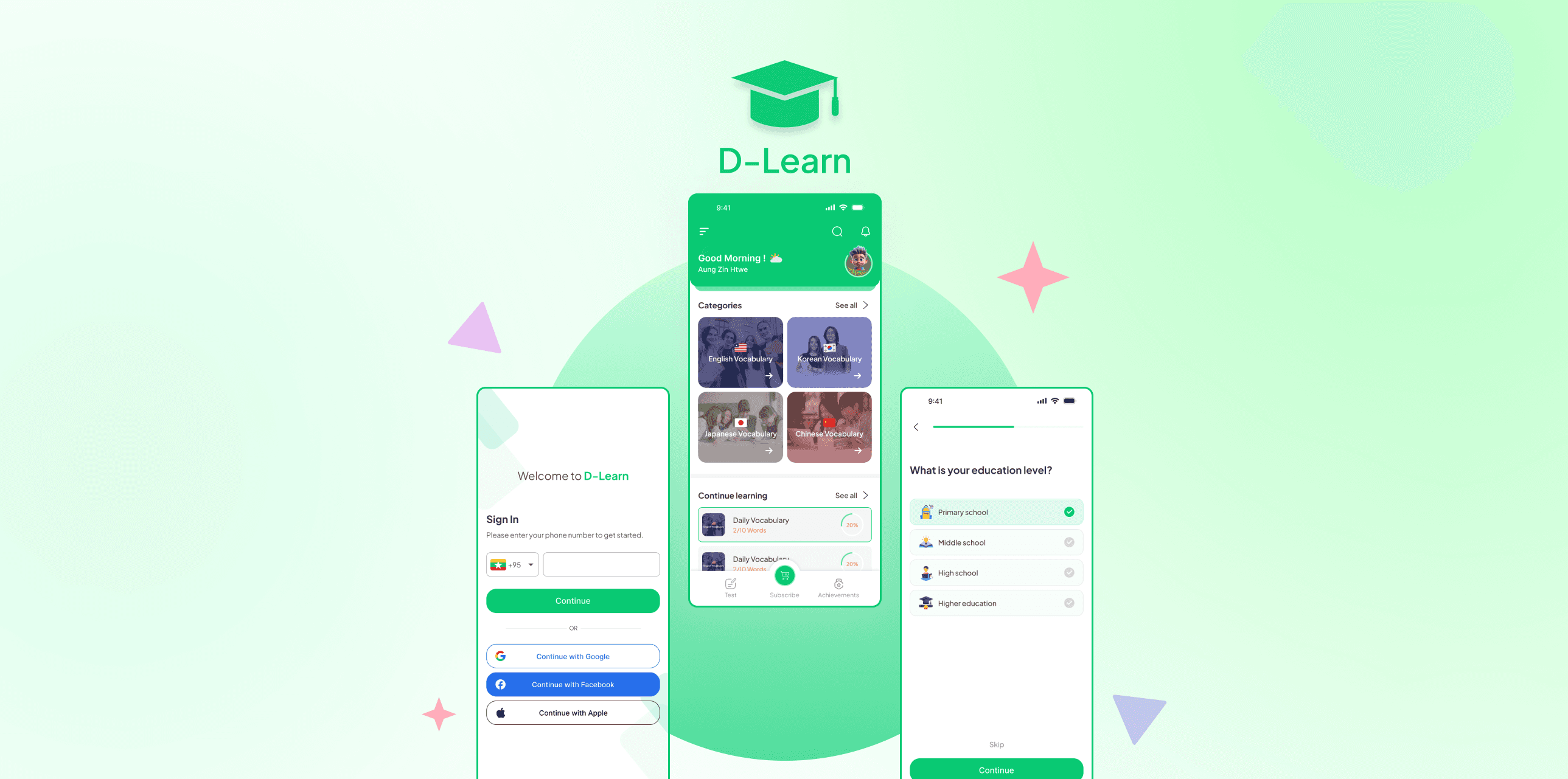
D-Learn Vocabulary Learning App
D-Learn Vocabulary Learning App
Role
UIUX Designer
Industry
Educational Platform
Duration
2 weeks
Role
UIUX Designer
UIUX Designer
Industry
Educitional Platform
Educitional Platform
Duration
2 weeks
2 weeks
About the Project
About the Project
This vocabulary learning app was designed as a competition entry, with the goal of helping users build their vocabulary in a fun, effective, and sustainable way. Within just two weeks, I conducted quick user validations and designed the core screens, focusing on an intuitive learning flow and motivational features. Through user insights, I discovered that many learners struggle with consistency and retention, especially when learning feels repetitive or overwhelming. This shaped my design approach — prioritizing daily microlearning, gamified interactions, and smart progress tracking to keep users engaged and confident in their learning journey.
This vocabulary learning app was designed as a competition entry, with the goal of helping users build their vocabulary in a fun, effective, and sustainable way. Within just two weeks, I conducted quick user validations and designed the core screens, focusing on an intuitive learning flow and motivational features. Through user insights, I discovered that many learners struggle with consistency and retention, especially when learning feels repetitive or overwhelming. This shaped my design approach — prioritizing daily microlearning, gamified interactions, and smart progress tracking to keep users engaged and confident in their learning journey.
Problem Statement
Problem Statement
Many language learners struggle to build a consistent vocabulary-learning habit due to lack of motivation, overwhelming content, and ineffective learning methods. Despite research suggesting that the average person can absorb around 15 new words per day, most vocabulary tools fail to support this pace in a structured and engaging way. Learners often miss out on contextual understanding, progress tracking, and gamified incentives that could drive long-term retention and daily commitment.
Many language learners struggle to build a consistent vocabulary-learning habit due to lack of motivation, overwhelming content, and ineffective learning methods. Despite research suggesting that the average person can absorb around 15 new words per day, most vocabulary tools fail to support this pace in a structured and engaging way. Learners often miss out on contextual understanding, progress tracking, and gamified incentives that could drive long-term retention and daily commitment.
The Goal
The Goal
The goal was to design a vocabulary learning app that enables users to confidently learn 15 new words each day through example-based learning, quick quizzes, and visual progress indicators. By integrating AI-driven personalization and motivational elements like badges and streaks, the app aims to make daily vocabulary practice both effective and enjoyable—turning a challenging routine into a rewarding experience.
The goal was to design a vocabulary learning app that enables users to confidently learn 15 new words each day through example-based learning, quick quizzes, and visual progress indicators. By integrating AI-driven personalization and motivational elements like badges and streaks, the app aims to make daily vocabulary practice both effective and enjoyable—turning a challenging routine into a rewarding experience.
Design Process
Design Process
Explore
Explore
Ideate
Ideate
Prototype
Prototype
Competitor Analysis
Competitor Analysis
While these platforms aren’t direct competitors, I conducted a competitive analysis to better understand their strengths and weaknesses—and to identify opportunities for achieving product-market fit. Duolingo and SAYA. I closely examined their content strategies, visual design, brand identity, and user interaction patterns to inform and refine my own design decisions.
While these platforms aren’t direct competitors, I conducted a competitive analysis to better understand their strengths and weaknesses—and to identify opportunities for achieving product-market fit. Duolingo and SAYA. I closely examined their content strategies, visual design, brand identity, and user interaction patterns to inform and refine my own design decisions.
D-Learn

SAYA
How might we ?
How might we ?
#1 HMW help users stay consistent with learning 15 new vocabulary words daily in a way that feels fun, manageable, and rewarding?
#1 HMW help users stay consistent with learning 15 new vocabulary words daily in a way that feels fun, manageable, and rewarding?
#2 HMW design an experience that combines contextual learning, quizzes, and personalized progress to boost vocabulary retention and engagement?
#2 HMW design an experience that combines contextual learning, quizzes, and personalized progress to boost vocabulary retention and engagement?

Ideation & Strategy
Ideation & Strategy
With a clear goal of helping users learn and retain 15 vocabulary words daily, we began the ideation process by focusing on how to break learning into simple, repeatable habits. Brainstormed features that would combine learning with motivation. Drawing from research, I realized that contextual examples, bite-sized quizzes, and visible progress are key to maintaining consistency. I also explored gamification strategies like badge rewards and streak systems to increase user motivation. AI integration was also considered early on to personalize the experience based on user performance. These ideas shaped the foundation of a product strategy that’s both user-centric and grounded in behavioral learning principles.
With a clear goal of helping users learn and retain 15 vocabulary words daily, we began the ideation process by focusing on how to break learning into simple, repeatable habits. Brainstormed features that would combine learning with motivation. Drawing from research, I realized that contextual examples, bite-sized quizzes, and visible progress are key to maintaining consistency. I also explored gamification strategies like badge rewards and streak systems to increase user motivation. AI integration was also considered early on to personalize the experience based on user performance. These ideas shaped the foundation of a product strategy that’s both user-centric and grounded in behavioral learning principles.
Core Screens
Core Screens
Due to privacy considerations, I’ll be sharing a high-level overview of the UI rather than detailed visuals.
Due to privacy considerations, I’ll be sharing a high-level overview of the UI rather than detailed visuals.
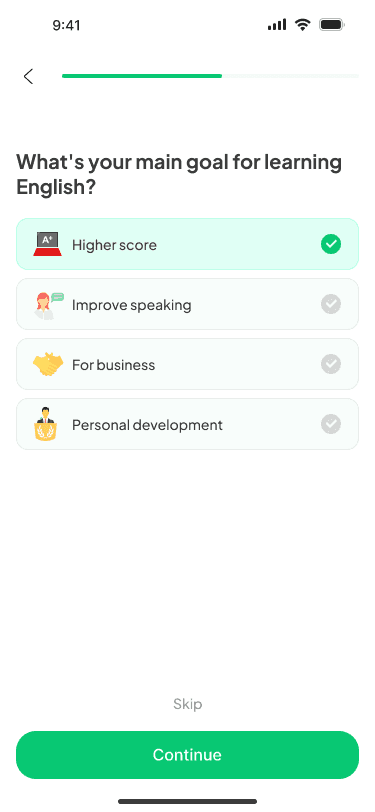
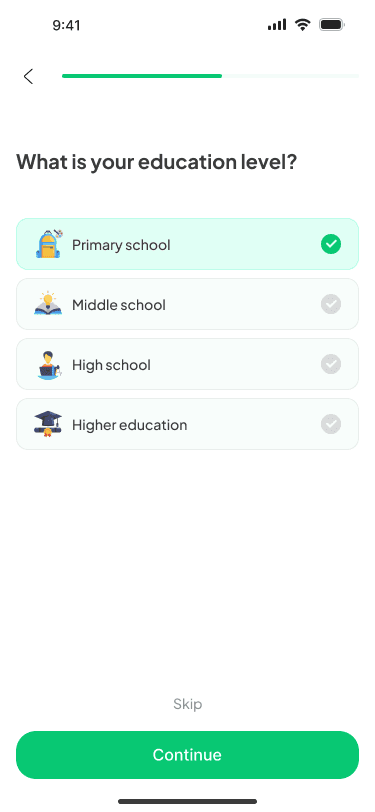
To offer personalized vocabulary exercises, the app asks for basic user information
To offer personalized vocabulary exercises, the app asks for basic user information
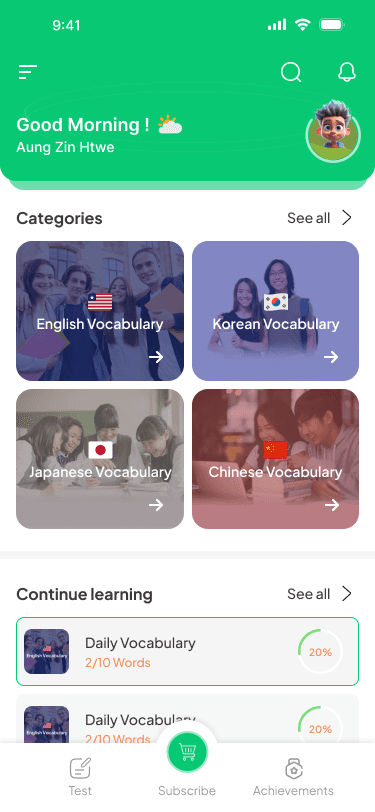
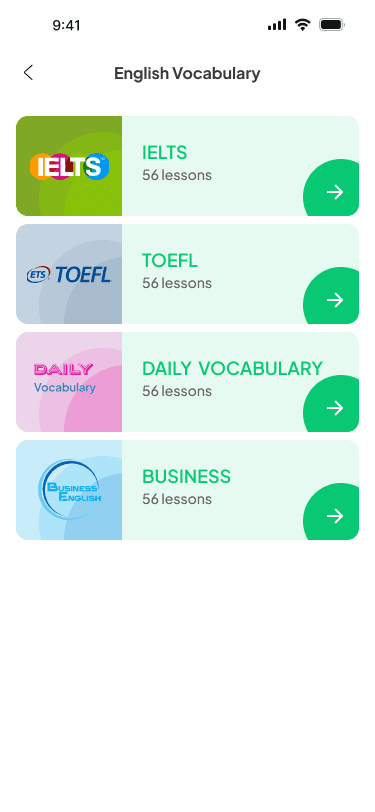
The home page is thoughtfully categorized to help users easily navigate and access their daily lessons.
The home page is thoughtfully categorized to help users easily navigate and access their daily lessons.
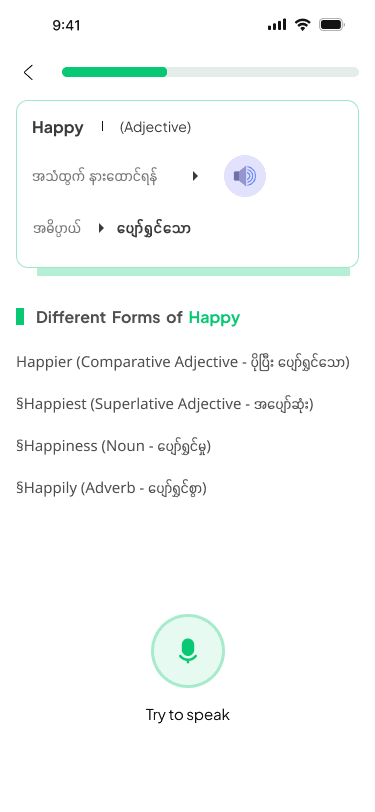
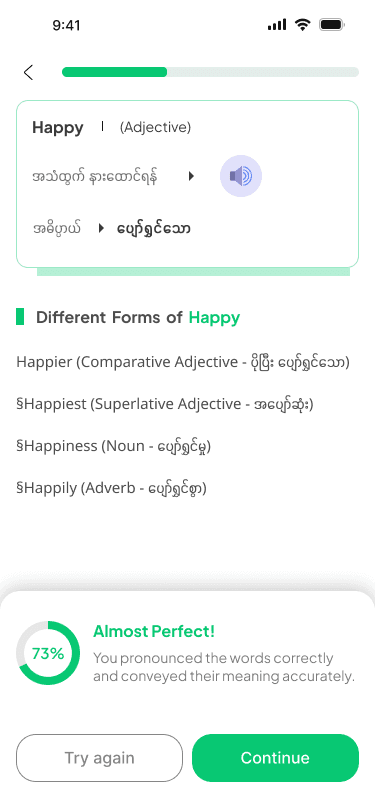
learn each vocabulary word through clear, well-explained examples and practice with quick quizzes
learn each vocabulary word through clear, well-explained examples and practice with quick quizzes
Reflection
Reflection
This project was a valuable learning experience, especially within a tight two-week timeline. Designing around user motivation, daily habits, and personalization helped me focus on what truly matters. The app design was appreciated for its clarity and smart features—making it well worth the effort. A key takeaway was how small, thoughtful details can create a more engaging and effective learning experience.
This project was a valuable learning experience, especially within a tight two-week timeline. Designing around user motivation, daily habits, and personalization helped me focus on what truly matters. The app design was appreciated for its clarity and smart features—making it well worth the effort. A key takeaway was how small, thoughtful details can create a more engaging and effective learning experience.
For Your Time
For Your Time
D-Learn Vocabulary Learning App
Role
UIUX Designer
Industry
Educational Platform
Duration
2 weeks
About the Project
This vocabulary learning app was designed as a competition entry, with the goal of helping users build their vocabulary in a fun, effective, and sustainable way. Within just two weeks, I conducted quick user validations and designed the core screens, focusing on an intuitive learning flow and motivational features. Through user insights, I discovered that many learners struggle with consistency and retention, especially when learning feels repetitive or overwhelming. This shaped my design approach — prioritizing daily microlearning, gamified interactions, and smart progress tracking to keep users engaged and confident in their learning journey.
Problem Statement
Many language learners struggle to build a consistent vocabulary-learning habit due to lack of motivation, overwhelming content, and ineffective learning methods. Despite research suggesting that the average person can absorb around 15 new words per day, most vocabulary tools fail to support this pace in a structured and engaging way. Learners often miss out on contextual understanding, progress tracking, and gamified incentives that could drive long-term retention and daily commitment.
Reflection
This project was a valuable learning experience, especially within a tight two-week timeline. Designing around user motivation, daily habits, and personalization helped me focus on what truly matters. The app design was appreciated for its clarity and smart features—making it well worth the effort. A key takeaway was how small, thoughtful details can create a more engaging and effective learning experience.
The Goal
The goal was to design a vocabulary learning app that enables users to confidently learn 15 new words each day through example-based learning, quick quizzes, and visual progress indicators. By integrating AI-driven personalization and motivational elements like badges and streaks, the app aims to make daily vocabulary practice both effective and enjoyable—turning a challenging routine into a rewarding experience.
Design Process
Explore
Ideate
Prototype
Competitor Analysis
Given the tight timeline, I adopted a Lean UX approach to design solutions. This methodology allowed me to stay focused on user needs, make data-informed decisions, and deliver value efficiently.
D-Learn
SAYA
Due to privacy considerations, I’ll be sharing a high-level overview of the UI rather than detailed visuals.
Core Screens
To offer personalized vocabulary exercises, the app asks for basic user information
The home page is thoughtfully categorized to help users easily navigate and access their daily lessons.
learn each vocabulary word through clear, well-explained examples and practice with quick quizzes
For Your Time
How might we ?
#1 HMW help users stay consistent with learning 15 new vocabulary words daily in a way that feels fun, manageable, and rewarding?
#2 HMW design an experience that combines contextual learning, quizzes, and personalized progress to boost vocabulary retention and engagement?
Ideation & Strategy
With a clear goal of helping users learn and retain 15 vocabulary words daily, we began the ideation process by focusing on how to break learning into simple, repeatable habits. Brainstormed features that would combine learning with motivation. Drawing from research, I realized that contextual examples, bite-sized quizzes, and visible progress are key to maintaining consistency. I also explored gamification strategies like badge rewards and streak systems to increase user motivation. AI integration was also considered early on to personalize the experience based on user performance. These ideas shaped the foundation of a product strategy that’s both user-centric and grounded in behavioral learning principles.